Company liquidation is the formal process of closing a business, settling its obligations, dealing with its assets, cancelling registrations, and removing the entity from the relevant commercial register.
However, not every company closes for the same reason or follows the same legal route. Some businesses are closed voluntarily because the shareholders have completed their commercial purpose. Others are forced into liquidation because of unpaid debts, legal disputes, regulatory breaches, or a court order.
Understanding the different types of liquidation in the UAE helps shareholders, directors, creditors, and employees know who controls the process, what documents are required, and whether court involvement may be necessary.
The two main legal categories are voluntary liquidation and involuntary or court-ordered liquidation. However, a complete explanation should also cover solvent liquidation, financially distressed closure, bankruptcy liquidation, authority-led closure, and the different procedures used for mainland, free-zone, offshore, and financial free-zone entities.
For professional support with any form of business closure, visit our company liquidation services in Dubai.
Quick Answer: What Are the Main Types of Liquidation in the UAE?
The main distinction is based on who starts the liquidation.
| Type of liquidation | Who normally starts it? | Typical reason | Court involvement |
| Voluntary liquidation | Shareholders or partners | Planned business closure, restructuring, completed project, or market exit | Usually limited |
| Involuntary or compulsory liquidation | Court, creditors, regulators, or another eligible party | Unpaid debts, disputes, legal violations, or inability to continue | Usually required |
| Bankruptcy liquidation | Debtor, qualifying creditors, or another eligible applicant through the bankruptcy process | The company cannot repay debts and rescue is no longer practical | Required |
| Authority-led closure | Licensing authority, regulator, ministry, or registrar | Long-term inactivity, non-compliance, or suspension of operations | May lead to court liquidation |
The UAE Commercial Companies Law recognises dissolution by shareholder agreement and dissolution through a court order. It also states that liquidation may be conducted by a liquidator appointed by the partners or general assembly, or by a liquidator appointed by the competent court.
Two Ways to Classify Company Liquidation
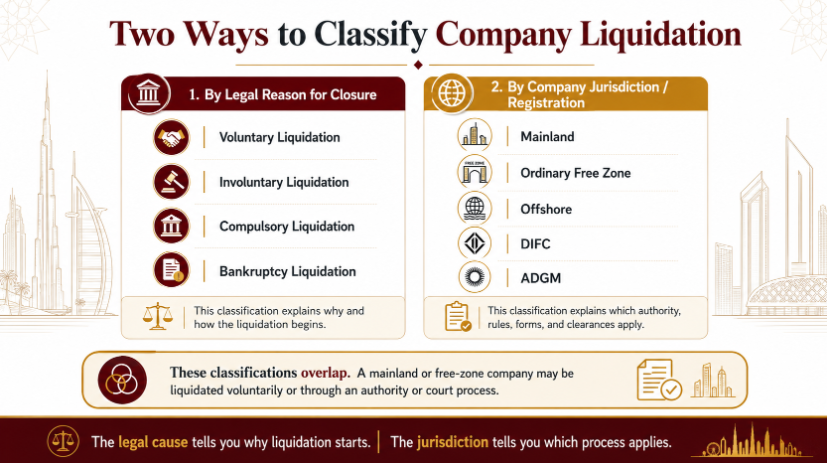
The phrase types of liquidation of a company in the UAE can refer to two different things.
The first classification is based on the legal reason for closure. This includes voluntary, involuntary, compulsory, and bankruptcy liquidation.
The second classification is based on where and how the company is registered. This includes mainland, ordinary free-zone, offshore, DIFC, and ADGM liquidation.
These classifications overlap. For example, a mainland company can enter voluntary or court-ordered liquidation. A free-zone company can also be closed voluntarily or through an authority or court process.
The legal cause tells you why and how the liquidation begins. The company’s jurisdiction tells you which authority, rules, forms, and clearances apply.
Type 1: Voluntary Company Liquidation
Voluntary liquidation happens when the shareholders or partners decide to close the company.
The decision is usually recorded through a formal shareholder or partner resolution. The resolution should confirm the decision to dissolve the company, explain the method of liquidation, and appoint a liquidator where required.
Under the UAE Commercial Companies Law, a company can be dissolved when its agreed duration expires, its purpose has been completed, most of its assets have been lost, it is merged, the partners agree to end it, or a court orders its dissolution. The law also states that when partners agree to dissolve a company, their agreement should include the method of liquidation and the liquidator’s name.
Voluntary liquidation may be used when the business is profitable, unprofitable, inactive, or no longer required. The key point is that the owners are making the decision rather than waiting for an external party to force the closure.
You can learn more through our dedicated voluntary company liquidation service in Dubai.
Solvent Voluntary Liquidation
A solvent voluntary liquidation takes place when the company can pay all its debts and closure expenses.
The company may have enough cash, receivables, property, inventory, or other assets to settle employees, suppliers, lenders, government fees, taxes, leases, professional costs, and other liabilities.
Once every obligation has been paid, the remaining funds or assets may be distributed to the shareholders according to their legal rights and shareholdings.
A solvent company may choose liquidation because its project has ended, the shareholders are retiring, the group is restructuring, or the owners are leaving the UAE market. The company does not need to be experiencing financial failure.
The UAE Commercial Companies Law states that shareholders or partners are not entitled to receive their share of the company’s capital until company debts have been paid. It also provides that liquidation proceeds are distributed among partners only after the company’s liabilities have been settled.
Is This the Same as Members’ Voluntary Liquidation?
International and competitor articles sometimes use the term members’ voluntary liquidation, or MVL, to describe the voluntary liquidation of a solvent company.
This term can help explain the company’s financial condition, but it should not automatically be treated as a separate official UAE procedure.
Federal Decree-Law No. 32 of 2021 mainly focuses on whether the liquidator is appointed by the partners or general assembly, or through a court order. The exact process is then affected by the company’s structure and licensing authority. Some competitor guides use the international MVL and creditors’ voluntary liquidation labels, while UAE legislation uses its own corporate and bankruptcy framework.
Voluntary Liquidation of a Financially Distressed Company
The owners of a financially distressed company may also decide that the business should close.
However, this should not be handled in exactly the same way as a straightforward solvent liquidation.
If the company cannot pay salaries, suppliers, loans, rent, taxes, or other debts, creditor rights become more important. The owners must determine whether the financial problem is temporary, whether the company can be restructured, and whether formal bankruptcy proceedings may apply.
A financially distressed company may have several possible options. These can include private creditor negotiations, preventive settlement, financial restructuring, the sale of business assets, or a formal bankruptcy process.
The current federal bankruptcy framework is Federal Decree-Law No. 51 of 2023, supported by Cabinet Resolution No. 94 of 2024. The framework provides methods intended to help viable distressed businesses avoid immediate bankruptcy and liquidation, including consensual restructuring and court-supervised rescue procedures.
Where the company has serious unpaid liabilities, shareholders should obtain legal, financial, and insolvency advice before treating the matter as an ordinary voluntary closure.
Our guide explains the issues involved when you need to liquidate a UAE business with outstanding debts.
Type 2: Involuntary or Compulsory Liquidation
Involuntary liquidation occurs when the closure is not controlled solely by the shareholders.
It may begin because a creditor, partner, regulator, or other eligible party asks a court or competent authority to intervene. It may also follow a legal judgment, regulatory action, or an unresolvable dispute between shareholders.
The terms compulsory liquidation, judicial liquidation, forced liquidation, and court-ordered liquidation are commonly used to describe this type of closure.
Under the Commercial Companies Law, one of the general causes of company dissolution is a court order. When liquidation is based on a court order, the competent court determines the method of liquidation and appoints the liquidator.
Common reasons for involuntary liquidation include long-standing unpaid debts, serious shareholder deadlock, major legal violations, loss of the company’s ability to operate, misuse of the legal entity, or failure to correct important regulatory problems.
Read more about this route through our involuntary company liquidation service in Dubai.
Creditor-Initiated Liquidation
A creditor may take legal action when a company repeatedly fails to pay an undisputed debt.
However, a creditor demand does not automatically mean that the company has already been liquidated. The creditor must follow the applicable legal route, and the court will review whether the conditions for the requested proceedings have been met.
The court may need to examine the debt, the company’s financial condition, available assets, disputes between the parties, and whether restructuring or another procedure is possible.
If the court orders liquidation, the company’s directors and shareholders lose much of their control over the process. The court-appointed liquidator or bankruptcy trustee then manages the relevant assets, creditor claims, reports, and distributions.
Court-Ordered Liquidation Following a Shareholder Dispute
Involuntary liquidation is not limited to unpaid creditor claims.
A shareholder or partner may seek court intervention where a serious dispute has made it impossible to continue the business. Examples may include complete management deadlock, misuse of company funds, exclusion of a shareholder from management, refusal to provide company records, or a fundamental breach of the memorandum of association.
The court will assess the evidence and decide whether dissolution and liquidation are legally justified. The existence of a dispute alone does not mean that liquidation will always be ordered.
Where possible, shareholders may first consider negotiation, mediation, a share transfer, buyout, restructuring, or an amendment to the company’s management arrangements.
Court liquidation is normally a final solution because it can involve additional legal costs, delay, public proceedings, and reduced shareholder control.
Type 3: Bankruptcy Liquidation
Bankruptcy liquidation is a formal court-supervised process used when a debtor cannot properly repay its debts and the business cannot realistically be rescued.
It is closely connected to involuntary liquidation, but the two terms should not always be used as exact replacements for each other.
A company may be dissolved by a court because of a shareholder dispute even when it is solvent. Bankruptcy, on the other hand, specifically concerns serious financial distress and collective creditor treatment.
The current UAE bankruptcy law defines bankruptcy as a set of procedures intended to settle the debtor’s debts collectively through liquidation of its assets and distribution of the proceeds among creditors. A bankruptcy status is established through a court judgment rather than simply because the company has missed a payment.
Before final bankruptcy liquidation, a viable company may be able to use preventive settlement or financial restructuring. These procedures are intended to protect value and improve creditor recovery where continued business remains possible.
Bankruptcy liquidation normally requires specialist legal, court, accounting, valuation, and insolvency support. It should not be treated as a standard trade licence cancellation.
Type 4: Regulatory or Authority-Led Liquidation
A company may also face closure action because a ministry, licensing authority, regulator, registrar, or free-zone authority determines that it is inactive or operating in breach of applicable requirements.
This may occur when the company has stopped conducting business, repeatedly failed to renew its licence, ignored regulatory notices, or continued serious non-compliance.
Under Article 310 of the Commercial Companies Law, the Ministry, Securities and Commodities Authority, or competent authority may notify a company that it will be deregistered where the company has stopped operating or is conducting business in breach of the law. If the situation is not corrected within the stated period, the matter may be referred to the competent court for liquidation.
The law also makes clear that deregistration does not automatically remove the existing liability of directors, managers, shareholders, or partners. Their liability may continue as though the company had not been dissolved.
This is why abandoning a company or allowing its licence to expire should not be viewed as an easy alternative to formal liquidation.
Voluntary vs Involuntary Liquidation in the UAE
The main differences between voluntary and involuntary liquidation concern control, reason, liquidator appointment, court involvement, and creditor pressure.
| Factor | Voluntary liquidation | Involuntary liquidation |
| Who starts it? | Shareholders or partners | Court, creditor, regulator, partner, or another eligible party |
| Main reason | Planned closure or owner decision | Debt, dispute, breach, insolvency, or legal order |
| Financial condition | May be solvent or financially distressed | Often distressed, but not always |
| Liquidator appointment | Normally by shareholders, partners, or general assembly | Normally by the competent court |
| Court involvement | Usually limited | Usually significant |
| Shareholder control | Greater at the beginning | Reduced after court intervention |
| Creditor involvement | Depends on the company’s liabilities | Usually stronger |
| Cost and complexity | Often easier to plan | Usually more legally complex |
| Final outcome | Company deregistration | Company deregistration after judicial process |
The Commercial Companies Law supports this distinction by providing for liquidator appointment either through the partners or general assembly or, where the liquidation is judicial, through the competent court.
Types of Liquidation Based on Company Jurisdiction
The legal type of liquidation is only one part of the process. The company’s place of registration also determines which authority handles the closure.
Mainland Company Liquidation
Mainland companies are licensed by the economic department or competent licensing authority in the relevant emirate.
A mainland liquidation may involve a notarised shareholder resolution, liquidator appointment, commercial-register filing, public creditor notice, employee and immigration clearances, lease cancellation, bank closure, tax deregistration, and final trade licence cancellation.
The UAE Commercial Companies Law requires the company’s dissolution to be recorded in the commercial register. It also requires publication of the dissolution notice in two local daily newspapers, with at least one published in Arabic. Creditors must generally be given at least 30 days from the liquidation notice to submit their claims under the federal law, although authority-specific procedures may impose additional requirements.
Capital Closure provides dedicated support for mainland company liquidation in Dubai.
Free-Zone Company Liquidation
Free-zone companies follow the rules of the authority with which they are registered.
The company may need to submit shareholder resolutions, appoint an approved liquidator, publish a creditor notice, settle facility fees, review visa cancellation requirements, close its establishment card, return leased premises, obtain customs clearance, submit final accounts, and collect a liquidation or deregistration certificate.
The exact process can vary significantly between DMCC, DAFZA, JAFZA, IFZA, RAKEZ, Dubai South, Meydan, DDA, and other UAE free zones.
Some authorities require a licensed liquidator and formal liquidation report for most companies. Others may provide a simplified deregistration procedure for particular dormant entities or branches.
Visit our free-zone company liquidation service for authority-specific closure support.
Offshore Company Liquidation
Offshore companies are normally used for holding assets, international activities, investments, or ownership structures rather than local UAE operations.
Their liquidation is generally handled through the relevant offshore registrar and registered agent. Examples include RAK ICC, JAFZA Offshore, and Ajman Offshore entities.
The process may require a shareholder resolution, declaration of solvency or financial statement, confirmation that liabilities have been settled, registered-agent clearance, bank-account closure, and final registrar approval.
An offshore company may have no UAE employees or office lease, but it can still have bank accounts, investments, assets, tax records, overseas obligations, or beneficial-ownership reporting responsibilities.
Learn more through our offshore company liquidation service in Dubai.
DIFC and ADGM Liquidation
DIFC and ADGM entities operate within separate financial free-zone legal systems.
Their liquidation and insolvency procedures should not automatically be treated as ordinary mainland or standard free-zone liquidation. They may involve their own company laws, insolvency regulations, registrars, courts, and financial regulators.
A regulated financial firm may also need approval or clearance from the Dubai Financial Services Authority in DIFC or the Financial Services Regulatory Authority in ADGM.
The company’s entity type is important. A regulated firm, holding company, foundation, special-purpose vehicle, or investment fund may each have different closure requirements.
Capital Closure offers specialist assistance for DIFC and ADGM entity liquidation.
Branch Closure and Deregistration
A branch is not always liquidated in exactly the same way as a separately incorporated company.
A branch normally forms part of its parent company and does not have fully independent ownership. Closing it may therefore be described as branch deregistration, licence cancellation, or termination of the branch registration.
The parent company may need to approve the closure, settle the branch’s local obligations, review employee visa cancellation obligations, close tax and bank records, and prepare supporting documentation for clearances from the relevant authority.
The parent entity may remain responsible for liabilities connected with the branch even after the UAE registration is cancelled.
Our foreign branch liquidation and closure service explains the process in more detail.
What Happens After a Company Is Dissolved?
Dissolution does not immediately end the company’s existence.
Under the Commercial Companies Law, a dissolved company retains its legal personality to the extent required for liquidation. The words “Under Liquidation” should be added clearly to the company’s name during this period.
The company continues to exist temporarily so that the liquidator can collect receivables, sell assets, pay debts, resolve claims, complete contracts that need to be finished, and prepare the final liquidation account.
The company ends legally after the liquidation is completed, the final account is approved, completion is registered, and the entity is removed from the commercial register.
The Role of the Liquidator
The liquidator manages the financial and legal winding-up of the company.
Immediately after appointment, the liquidator should review the company’s assets and liabilities. The company’s management must provide its accounts, records, documents, and property to the liquidator.
The liquidator prepares a detailed balance sheet and list of assets and liabilities, collects money owed to the company, protects company property, deals with creditors, pays debts, sells assets where necessary, and prepares the final liquidation account.
The liquidator also represents the company before courts and third parties during the liquidation.
The appointment and method of liquidation must be entered in the commercial register before they become effective against third parties. The liquidator’s appointment document should also establish the applicable fee or allow the competent court to determine it.
The correct liquidator should be selected at the beginning because changing the liquidator later requires another formal resolution or court order and a new commercial-register entry.
Steps Common to Most Types of Liquidation
Although the procedure changes according to the legal type and jurisdiction, most company liquidations include a similar core process.
The company first reviews its legal, financial, tax, employee, banking, contractual, and regulatory position. This determines whether it is solvent and whether a voluntary route is safe.
The shareholders, partners, court, or authority then issue the relevant dissolution decision and appoint the liquidator where required.
Creditors are notified and given an opportunity to submit claims. The liquidator identifies the company’s assets and liabilities, collects outstanding receivables, settles creditors, and deals with employee entitlements.
The business then completes its authority clearances, visa cancellations, establishment-card closure, office handover, bank-account closure, and tax deregistration.
Finally, the liquidator prepares the final account or liquidation report. Once this is approved, completion is registered and the company is removed from the commercial register.
Our guide to the documents and resolutions required for company liquidation explains the supporting records in more detail.
Tax Deregistration During Liquidation
Trade licence cancellation does not automatically close the company’s VAT or Corporate Tax registrations.
A VAT-registered business must separately apply for VAT deregistration where the applicable conditions are met. The Federal Tax Authority states that a mandatory VAT deregistration application generally needs to be submitted within 20 business days from the date the deregistration obligation arises. The company must also submit its final VAT return and settle payable tax within the applicable period.
A company that ceases business through dissolution or liquidation must also review its Corporate Tax registration. The FTA has confirmed that the Corporate Tax deregistration application is generally due within three months from the deregistration-triggering event.
Outstanding returns, penalties, information requests, or tax payments can delay approval. Tax closure should therefore be planned alongside the company liquidation rather than left until the final day.
For further information, review our VAT deregistration service in Dubai.
How Company Assets Are Treated
Company property does not immediately become the personal property of the shareholders when liquidation starts.
The liquidator must first identify, protect, collect, or sell the assets. The proceeds are then used to settle liquidation expenses and company debts.
Where the company has enough assets, all creditors can be paid and the remaining value can be distributed among shareholders.
Where the assets are insufficient, preferred creditor rights and bankruptcy rules may become relevant. Shareholders will normally receive nothing unless the creditor claims and liquidation costs have been dealt with.
The Commercial Companies Law prohibits partners and shareholders from receiving their share of capital before company debts have been paid.
Removing cash, vehicles, equipment, inventory, receivables, or intellectual property before reviewing creditor claims can create disputes and possible personal consequences for the people involved.
How to Choose the Correct Type of Liquidation
The first question is whether the owners are choosing the closure or an external party is forcing it.
The second question is whether the company can pay every employee, creditor, government charge, tax liability, and liquidation expense.
A solvent company whose owners have made a final decision to exit will usually consider voluntary liquidation.
A temporarily distressed company with a viable business may need restructuring or creditor negotiation rather than immediate liquidation.
A company that cannot pay its obligations and has no realistic recovery plan may need insolvency or bankruptcy advice.
Where a court case, regulatory notice, creditor petition, or shareholder claim has already started, urgent legal review may be necessary before any ordinary licence-cancellation steps are taken.
Practical Examples of UAE Liquidation Types
Example 1: Solvent Voluntary Liquidation
A Dubai consultancy has completed its final client contract. It has no employees, enough money to pay all suppliers and taxes, and no outstanding loans.
The shareholders decide to leave the UAE market and approve a formal liquidation.
This is a solvent voluntary liquidation.
Example 2: Voluntary Closure of a Distressed Business
A trading company has declining sales and overdue supplier invoices. The shareholders want to close before the debts increase.
Before proceeding, the company reviews its assets, liabilities, and cash flow. It negotiates settlements with creditors and determines whether it can complete an orderly voluntary closure.
This is shareholder-initiated liquidation, but the company’s financial distress requires greater creditor and insolvency planning.
Example 3: Court-Ordered Liquidation
Two equal shareholders have a serious dispute and the company can no longer make decisions, access funds, or continue operations.
One shareholder applies to the court for dissolution. The court reviews the case and appoints a liquidator.
This is judicial or compulsory liquidation, even if the company has enough assets to pay its debts.
Example 4: Bankruptcy Liquidation
A construction company has stopped paying employees, banks, and subcontractors. Its liabilities are much greater than its remaining assets, and there is no realistic restructuring plan.
Formal bankruptcy proceedings begin, and the company’s assets are dealt with under court supervision.
This is bankruptcy liquidation.
Example 5: Authority-Led Closure
A company stops operating, does not renew its licence, and ignores several authority notices.
The competent authority begins deregistration action and may refer the company to the court for liquidation.
This is an authority-led or regulatory closure route.
Common Mistakes When Identifying the Liquidation Type
Treating Every Closure as Voluntary Liquidation
A company facing a court petition, bankruptcy application, or regulatory order may no longer control the process. Ordinary shareholder resolutions may not be enough.
Assuming Every Insolvent Company Must Close
Some financially distressed companies can be rescued through restructuring, new investment, asset sales, or creditor agreements.
Using Foreign Terminology Without Checking UAE Law
Members’ voluntary liquidation and creditors’ voluntary liquidation are useful international descriptions, but they should not replace analysis of the UAE Commercial Companies Law, Bankruptcy Law, company jurisdiction, and authority rules.
Confusing Licence Expiry With Liquidation
An expired licence does not necessarily mean that the company has been formally dissolved or removed from government, immigration, banking, and tax records.
Distributing Assets Before Creditor Claims Are Settled
The company’s assets must first be used for its liabilities and liquidation expenses. Shareholders receive only the properly calculated remaining balance.
Starting a Normal Closure During Court Proceedings
Where a creditor, shareholder, or authority has already started legal proceedings, the company should obtain legal advice before transferring assets, paying selected creditors, or completing ordinary deregistration steps.
How Capital Closure Can Help
Capital Closure supports companies across the different types of liquidation in the UAE.
Capital Closure provides advisory, accounting-record review and documentation-preparation support for company closure requirements. We help identify applicable requirements and prepare a company-specific checklist. Relevant authorities process official applications and issue their own decisions and certificates.
For involuntary or financially distressed cases, we help identify outstanding liabilities, gather company records, coordinate with approved liquidators, and organise the administrative closure work. Court, bankruptcy, and contested creditor matters should also be handled with appropriately qualified UAE legal and insolvency professionals.
We assist mainland, free-zone, offshore, branch, DIFC, and ADGM entities through a process designed around their legal structure and authority requirements.
Our objective is to identify the correct closure route before documents are submitted, reducing the risk of rejected applications, creditor disputes, unnecessary costs, and open compliance obligations.
Conclusion
Understanding the different types of liquidation in the UAE is essential before beginning any company closure. Voluntary liquidation is generally used when shareholders decide to close the business, while involuntary or compulsory liquidation may result from creditor action, a court order, regulatory action, or a serious shareholder dispute. Bank
ruptcy liquidation is different because it deals specifically with companies that cannot repay their debts and have no realistic recovery plan.
The correct process also depends on where the company is registered. Mainland, free-zone, offshore, DIFC, ADGM, and branch entities can follow different rules, documentation requirements, creditor-notice procedures, and authority clearances. Choosing the wrong route may cause delays, rejected applications, open tax registrations, creditor disputes, or additional costs.
Before starting the liquidation, shareholders should review the company’s financial position, outstanding debts, employee obligations, tax registrations, bank accounts, licences, and legal matters. A structured review makes it easier to select the correct closure method and complete the process without leaving unresolved liabilities.
Frequently Asked Questions
What are the two main types of company liquidation in the UAE?
The two main legal types are voluntary liquidation and involuntary or compulsory liquidation. Voluntary liquidation is initiated by the company’s shareholders or partners. Involuntary liquidation normally follows court, creditor, regulator, or other external action.
What is voluntary liquidation?
Voluntary liquidation is a formal closure approved by shareholders or partners. It may be used by a solvent company completing its commercial purpose or by a distressed company whose owners have decided that it should no longer continue.
What is involuntary liquidation?
Involuntary liquidation is a forced or judicial closure. It may result from a court judgment, creditor action, serious shareholder dispute, regulatory breach, or financial failure.
Is compulsory liquidation the same as bankruptcy?
Not always. Compulsory liquidation may be ordered because of a legal dispute or another accepted reason even where the company is solvent. Bankruptcy specifically relates to serious financial distress and collective settlement of creditor claims through the court-supervised bankruptcy framework.
Can a solvent company enter liquidation?
Yes. A solvent company can be liquidated voluntarily when the owners want to retire, leave the market, restructure the group, or end a completed project.
Can an insolvent company enter voluntary liquidation?
The shareholders may choose to start closure, but a company that cannot pay its debts requires careful insolvency analysis. Creditor rights, restructuring options, and the UAE Bankruptcy Law must be considered before using an ordinary voluntary process.
Who appoints the liquidator?
In voluntary liquidation, the liquidator is normally appointed by the partners, shareholders, general assembly, or equivalent company body. In a court-ordered liquidation, the competent court appoints the liquidator and determines the method of liquidation.