The words “liquidation,” “insolvency,” and “bankruptcy” are often used as though they mean the same thing. In reality, each term describes a different financial or legal situation.
Insolvency describes a financial problem. It generally means that a business cannot pay its debts when they become due or that its financial position has seriously weakened. Liquidation is the formal process of closing a company, settling its obligations, dealing with its assets, and removing it from the business register. Bankruptcy is a court-supervised legal process used to deal collectively with the debts of a financially distressed debtor.
Understanding liquidation vs insolvency in the UAE is important because a company can be liquidated without being insolvent, and an insolvent business does not automatically become bankrupt.
The correct option depends on whether the company can pay its debts, whether the business can recover, whether creditors are taking legal action, and whether the owners want to continue or permanently close the company.
For support with a planned business closure, you can review our company liquidation services in Dubai.
Quick Answer: What Is the Difference?
The simplest way to understand the liquidation, insolvency, and bankruptcy difference in the UAE is this:
| Term | What It Means | Does the Company Close? | Is Court Involvement Required? |
| Insolvency | The company cannot pay debts or has a serious financial deficit | Not automatically | Not automatically |
| Liquidation | The company’s affairs are wound up and the entity is closed | Usually yes | Not always |
| Bankruptcy | A collective legal process for dealing with an insolvent debtor’s debts and assets | Often leads to asset liquidation | Yes |
Insolvency is therefore a financial condition. Liquidation is a closure procedure. Bankruptcy is a formal court process.
These concepts can overlap, but they should not be treated as identical.
Important Update to the UAE Bankruptcy Law
The current federal framework is Federal Decree-Law No. 51 of 2023 concerning Financial Restructuring and Bankruptcy, together with its 2024 Executive Regulations.
The 2023 legislation repealed the earlier Federal Decree-Law No. 9 of 2016. This is an important point because many online articles still explain UAE bankruptcy using the old 2016 rules, terminology, deadlines, and financial limits.
The current law aims to protect creditors while also helping financially distressed businesses avoid liquidation and bankruptcy where recovery remains possible. It provides procedures such as preventive settlement and financial restructuring, alongside bankruptcy and asset liquidation.
Any business facing serious financial pressure should therefore obtain advice based on the current law rather than relying on older bankruptcy guides.
What Does Insolvency Mean in the UAE?
Insolvency describes a situation in which a company or other debtor is unable to meet its financial obligations properly.
A company may experience cash-flow insolvency when it does not have enough available money to pay salaries, rent, suppliers, loan instalments, taxes, or other debts when they fall due. This can happen even when the company owns valuable assets.
A company may also have a weak balance-sheet position where the value of its liabilities is greater than the value of its assets. In that situation, selling everything the company owns may still not raise enough money to pay all creditors.
The current UAE law defines cessation of payment as a failure to pay a due debt after ten days have passed beyond the deadline stated in the relevant notice. It also recognises instability in the debtor’s financial position where the debtor has failed, or is expected to fail, to pay due debts within three months because of financial distress.
However, missing one payment does not mean that every company should immediately be liquidated. The financial problem may be temporary and capable of being corrected through new funding, debt rescheduling, collection of customer invoices, cost reductions, or formal restructuring.
Insolvency is therefore a warning about the company’s financial health. It does not, by itself, automatically close the company or establish bankruptcy.
What Is Company Liquidation?
Company liquidation is the formal process of winding up a business.
During liquidation, the company stops taking on unnecessary new activity, reviews its assets and liabilities, collects money owed to it, settles employee and creditor claims, closes registrations, cancels its trade licence, and distributes any remaining funds according to the applicable rules.
A liquidator may be appointed to manage the process. The liquidator can review the accounts, identify assets, communicate with creditors, prepare reports, settle obligations, and support the company’s final deregistration.
Once the process is completed, the company normally stops existing as a registered legal entity.
You can find a wider breakdown in our guide to the company liquidation process in Dubai.
A Company Does Not Need to Be Insolvent to Enter Liquidation
One of the most important differences between insolvency and liquidation is that liquidation does not always involve financial failure.
A solvent company may be liquidated because its shareholders have completed a project, are retiring, are leaving the UAE market, are restructuring a group of companies, or no longer wish to operate the business.
In a solvent liquidation, the company should have enough assets and funds to pay its employees, government charges, taxes, suppliers, lenders, and other creditors. Any remaining value may then be distributed to shareholders.
This is generally known as voluntary liquidation because the owners have decided to close the company even though it can meet its obligations.
Our voluntary company liquidation service explains how a planned and solvent business closure is normally handled.
An insolvent company may also be liquidated. The major difference is that there may not be enough money to pay every creditor in full. Creditor rights, asset protection, payment priorities, court procedures, and management conduct then become much more important.
What Is Bankruptcy in the UAE?
Bankruptcy is a formal legal process supervised by the Bankruptcy Court.
The current UAE law defines bankruptcy as a set of measures aimed at settling a debtor’s debts collectively by liquidating the debtor’s assets and business and distributing the proceeds among creditors.
Unlike general financial distress, bankruptcy is not established simply because someone says that the business is bankrupt. The law states that bankruptcy is established through a judgment declaring bankruptcy.
Bankruptcy proceedings may be considered where the debtor cannot repay its debts, has a deficit in its financial position, and the continuation of the business is not viable. The court then considers the debtor’s financial position, creditor interests, available assets, and whether another rescue procedure is realistic.
Once bankruptcy proceedings are underway, a trustee may be appointed to deal with the bankruptcy estate, review creditor claims, protect assets, and manage the liquidation and distribution process under court supervision.
This is different from an ordinary solvent liquidation arranged by shareholders and the relevant licensing authority.
Insolvency vs Liquidation in Dubai: How Do They Connect?
Insolvency and liquidation may happen together, but they are not automatically linked.
Consider a company that has enough assets and available cash to pay every obligation. The shareholders may choose voluntary liquidation because they want to leave the market. The company is being liquidated, but it is not insolvent.
Now consider a company that cannot pay suppliers this month but owns valuable property and expects to receive a major customer payment within several weeks. The company may be experiencing cash-flow insolvency, but liquidation may not be necessary if the financial problem can be resolved.
A third company may have large unpaid debts, limited assets, no realistic future revenue, and several creditor claims. In that case, financial restructuring may not be practical, and court-supervised bankruptcy or insolvent liquidation may need to be considered.
The correct route depends on the depth of the financial problem and whether the underlying business remains viable.
Liquidation vs Bankruptcy in the UAE
Liquidation and bankruptcy are closely connected because bankruptcy can lead to the liquidation of the debtor’s assets. However, liquidation can also take place without bankruptcy.
A voluntary solvent liquidation is normally initiated by the owners. Its main purpose is to settle all obligations and close the company properly. It may involve the licensing authority, a liquidator, employees, tax authorities, banks, landlords, and other parties, but it does not necessarily require a bankruptcy judgment.
Bankruptcy is initiated through a formal legal application and managed under the authority of the Bankruptcy Court. Its main purpose is to deal collectively with debts where the debtor is unable to pay and the business is not viable.
In simple terms, liquidation can be a commercial exit decision. Bankruptcy is a legal response to serious financial failure.
Is Bankruptcy the Only Option for an Insolvent Company?
No. UAE law is designed, where reasonably possible, to help a viable business deal with its debts without immediately ending its operations.
A financially distressed company may be able to negotiate privately with creditors. This could involve extending payment dates, reducing instalments, selling non-essential assets, obtaining new investment, converting debt into another arrangement, or agreeing on a structured settlement.
The current federal law also provides formal preventive settlement and financial restructuring procedures. These procedures are intended to help a debtor continue operating while dealing with creditor claims through a court-supervised proposal or plan.
Under preventive settlement, the debtor may generally continue managing its business and assets unless the Bankruptcy Court decides otherwise. During restructuring proceedings, management may continue under the supervision of the appointed trustee.
These procedures may be suitable when the business has a realistic path back to profitability. Where the business has no viable future, liquidation or bankruptcy may be more responsible than allowing debts to grow.
When Is Voluntary Liquidation More Suitable?
Voluntary liquidation may be suitable where the shareholders have made a final decision to close and the company can settle its obligations.
For example, a consultancy may have completed its contracts, collected its customer payments, paid its employees, and have enough funds to clear all remaining expenses. The shareholders may then pass the required resolution, appoint a liquidator where necessary, cancel registrations, close the bank account, and complete company deregistration.
The fact that the business is closing does not mean that it failed or became bankrupt. It may simply have reached the end of its commercial purpose.
A company considering this route should prepare the correct resolutions, financial records, clearance certificates, tax documents, visa cancellation records, and authority applications. Our guide explains the main documents and resolutions required for company liquidation.
When May Insolvent Liquidation or Bankruptcy Be Necessary?
An insolvent closure may need to be considered when the company cannot pay its obligations and there is no reasonable rescue plan.
Common signs include repeated failure to pay employees, overdue loan instalments, several creditor notices, returned payments, unpaid government charges, growing legal claims, negative cash flow, and a lack of realistic future revenue.
The company’s management should not wait until all available cash and assets have disappeared. An early financial review may show whether restructuring, creditor negotiation, asset sale, new investment, voluntary closure, or formal bankruptcy proceedings are more suitable.
Where creditors, courts, or regulatory authorities force the company toward closure, the matter may become an involuntary liquidation. You can review our involuntary company liquidation service for further context.
Which UAE Law Applies?
The correct legal framework depends on who owes the debt and where the entity is registered.
Federal Decree-Law No. 51 of 2023 generally applies to companies governed by the UAE Commercial Companies Law, natural persons who have the legal capacity of a trader, and licensed professional civil companies.
However, it does not apply in the same way to every entity. Government-owned entities with special insolvency provisions, certain free-zone entities governed by separate procedures, banks, financial institutions, insurance companies subject to special legislation, and personal or family consumer debts may fall outside its general scope.
This distinction is particularly important for businesses registered in financial free zones such as the Dubai International Financial Centre or Abu Dhabi Global Market, which may be subject to their own insolvency rules.
The company’s legal form, licensing authority, activity, debt type, and place of registration should therefore be confirmed before deciding which process applies.
What About Personal Insolvency?
Personal insolvency should not be confused with company bankruptcy.
Federal Decree-Law No. 19 of 2019 regulates insolvency procedures for natural persons in relevant non-business situations. The framework allows qualifying individuals facing existing or expected financial difficulty to seek a court-supervised arrangement for settling their financial obligations.
A company owner may also have personal exposure through guarantees, personal borrowing, or misconduct. However, a company’s financial problems do not automatically mean that the owner is personally insolvent.
The company and its owners should be reviewed separately. This is especially important where directors or shareholders signed personal guarantees for bank loans, leases, supplier credit, or other company obligations.
Does Licence Cancellation Clear Company Debts?
No. Cancelling a trade licence does not automatically remove unpaid debts.
The company should settle or properly address its obligations to employees, creditors, banks, landlords, government departments, customers, and tax authorities.
A company may cancel or allow its licence to expire while still having an outstanding bank account, Corporate Tax registration, VAT account, employee claim, creditor dispute, or legal case. That does not create a clean legal exit.
Where the company has outstanding debts, the owners should identify whether the business is solvent, temporarily distressed, or insolvent before beginning ordinary licence cancellation.
Our guide explains whether you can liquidate a business in Dubai with outstanding debts.
What Happens to Company Assets?
During a solvent liquidation, company assets may be sold or converted into cash so that liabilities and closure costs can be paid. Once every obligation has been settled, the remaining balance may be distributed to the shareholders according to their rights.
During bankruptcy, the debtor’s available assets form part of the bankruptcy estate. The trustee manages or liquidates those assets and distributes the proceeds according to the creditor rankings and procedures established by law.
Shareholders should not remove cash, equipment, stock, intellectual property, or other company property simply because they own the company. Company assets belong to the legal entity and must be handled through the correct process.
Transferring valuable assets for little or no payment, hiding property, creating false debts, or favouring one creditor to harm others can create serious legal consequences.
Can Directors Become Personally Liable?
A limited liability company normally has a legal identity separate from its shareholders and managers. However, limited liability does not protect every type of conduct.
Personal consequences may arise where there are personal guarantees, fraud, concealment of assets, misuse of company funds, false accounting records, improper distributions, serious management failures, or other breaches of legal duties.
The current bankruptcy law includes penalties for conduct such as hiding or destroying records, disposing of assets to keep them away from creditors, recognising false debts, and making improper preferential payments after financial failure.
Financial difficulty itself is not automatically a criminal act. The greater risk arises when directors or managers hide the true position, continue harmful conduct, or move assets in a way that prejudices creditors.
Directors should preserve accounting records, stop unusual asset transfers, document decisions, and obtain legal and financial advice as soon as serious insolvency becomes likely.
Practical Decision Guide
The following questions can help clarify the company’s position:
| Question | Likely Direction |
| Can the company pay every debt and closure expense? | Solvent voluntary liquidation may be suitable |
| Is the cash shortage temporary and the business still viable? | Negotiation, preventive settlement, or restructuring may be considered |
| Are liabilities greater than available assets? | Insolvency advice and creditor planning are needed |
| Is the company unable to pay and no longer commercially viable? | Bankruptcy or insolvent liquidation may need to be considered |
| Are creditors or authorities already taking action? | Urgent legal review may be required |
| Are the owners simply leaving the market? | Planned voluntary liquidation may be appropriate |
This is only an initial guide. A proper decision requires review of the company’s accounts, creditor claims, assets, guarantees, contracts, tax position, and authority requirements.
Practical Examples
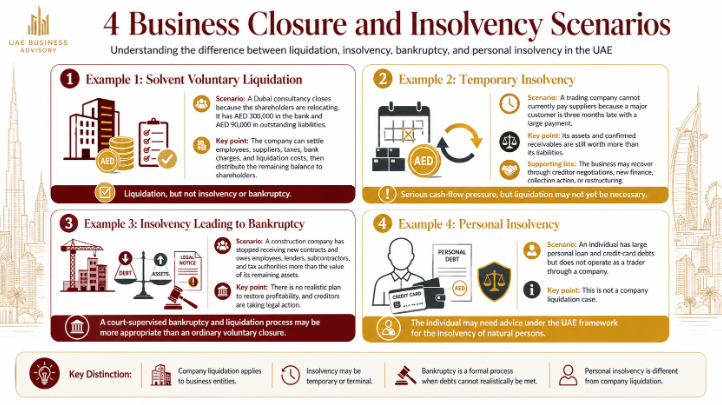
Example 1: Solvent Voluntary Liquidation
A Dubai consultancy decides to close because the shareholders are relocating. It has AED 300,000 in the bank and only AED 90,000 in outstanding liabilities.
The company can settle its employees, suppliers, taxes, bank charges, and liquidation costs. It can then distribute the remaining balance to the shareholders.
This is liquidation, but it is not insolvency or bankruptcy.
Example 2: Temporary Insolvency
A trading company cannot pay suppliers because a major customer is three months late with a large payment. The company’s assets and confirmed receivables are still worth more than its liabilities.
The company is experiencing serious cash-flow pressure, but it may be able to recover through creditor negotiations, new finance, collection action, or restructuring.
Liquidation may not yet be necessary.
Example 3: Insolvency Leading to Bankruptcy
A construction company has stopped receiving new contracts. It owes employees, lenders, subcontractors, and tax authorities more than the value of its remaining assets.
There is no realistic plan to restore profitability. Creditors have issued notices and are taking legal action.
In this situation, a court-supervised bankruptcy and liquidation process may be more appropriate than an ordinary voluntary closure.
Example 4: Personal Insolvency
An individual has large personal loan and credit-card debts but does not operate as a trader through a company.
This is not a company liquidation case. The individual may need advice under the UAE framework for the insolvency of natural persons.
Common Misunderstandings
“An Insolvent Company Is Automatically Bankrupt”
Insolvency is a financial condition. Bankruptcy requires formal legal proceedings and a bankruptcy judgment.
An insolvent company may still negotiate with creditors or complete a restructuring if the business remains viable.
“Every Liquidated Company Has Failed”
A solvent company can be liquidated because its owners have completed its purpose or no longer wish to continue.
Liquidation is not always evidence of poor performance.
“Licence Cancellation Removes All Liabilities”
A trade licence is only one part of the company’s legal and compliance position. Debts, taxes, visas, bank accounts, employee claims, and contracts must be dealt with separately.
“Company Assets Can Be Transferred to Shareholders Before Closure”
Assets should not be distributed until creditors and closure obligations have been addressed. Improper transfers can be challenged and may create liability.
“Bankruptcy Always Means Fraud”
A genuine commercial failure is not automatically fraud. However, hiding assets, falsifying liabilities, destroying records, or prejudicing creditors can lead to penalties.
Why Acting Early Matters
The earlier a company reviews its financial position, the more options it may have.
A business that still has customers, skilled employees, useful assets, and a realistic operating model may be capable of restructuring. Waiting until cash has disappeared, employees have left, and several creditors have filed claims can reduce the chance of recovery.
Early action also gives management time to prepare reliable accounts, identify personal guarantees, preserve assets, communicate with creditors, and avoid unnecessary transactions.
The company should prepare a short-term cash-flow forecast, a complete creditor list, an asset register, an employee liability calculation, details of bank facilities, and a list of pending court or government matters.
These records help professional advisers determine whether the business should continue, restructure, sell assets, negotiate settlements, or begin liquidation.
How Capital Closure Can Help
Capital Closure supports UAE businesses that need to understand whether their situation involves a planned company closure, voluntary liquidation, creditor pressure, or a more complex insolvent exit.
Capital Closure provides advisory, accounting-record review and documentation-preparation support for company closure requirements. We help identify applicable requirements and prepare a company-specific checklist. Relevant authorities process official applications and issue their own decisions and certificates.
Where court proceedings, insolvency disputes, or formal bankruptcy advice are required, the case should also be reviewed by appropriately qualified UAE legal and insolvency professionals.
Our objective is to help business owners understand the difference between insolvency vs liquidation in Dubai, identify unresolved risks, and follow a structured and compliant exit process.
Conclusion
Understanding the difference between liquidation, insolvency, and bankruptcy helps UAE business owners choose the right response before financial problems become harder to manage. Insolvency describes a company’s financial condition, liquidation is the formal process of closing a company, and bankruptcy is a court-supervised legal procedure for dealing with serious financial failure. These terms can overlap, but they do not mean the same thing.
A solvent company may enter voluntary liquidation even when it can pay all its debts. A financially distressed company may still be able to recover through creditor negotiations, preventive settlement, new funding, or restructuring. Bankruptcy may become relevant when the company cannot repay its obligations, has insufficient assets, and no realistic recovery plan remains.
The correct route depends on the company’s cash flow, assets, liabilities, creditor claims, personal guarantees, business viability, and jurisdiction. Acting early gives directors more time to protect company assets, organise financial records, communicate with creditors, and consider alternatives before court action begins.
Frequently Asked Questions
What is the main difference between insolvency and liquidation?
Insolvency means that a company cannot properly meet its financial obligations. Liquidation is the formal process used to wind up and close a company. Insolvency may lead to liquidation, but a solvent company can also be liquidated voluntarily.
Is insolvency the same as bankruptcy in the UAE?
No. Insolvency describes the debtor’s financial condition. Bankruptcy is a formal legal process established through a court judgment.
Can a solvent company be liquidated?
Yes. Shareholders may voluntarily liquidate a solvent company when they want to leave the market, finish a project, restructure their group, or permanently stop the business.
Can an insolvent company continue trading?
An insolvent business may sometimes continue through creditor agreements, preventive settlement, or financial restructuring if the business remains viable. The company should obtain legal and financial advice before continuing normal activity.
Does bankruptcy always result in liquidation?
Under the current UAE federal law, bankruptcy is a collective process involving the liquidation of the debtor’s assets and distribution of proceeds to creditors. However, financially distressed companies may have restructuring options before bankruptcy is declared.
Can creditors force a company into bankruptcy?
Qualifying creditors may apply to initiate bankruptcy proceedings where the applicable legal conditions are met, including requirements concerning the debt and prior notice to the debtor.
Can a company be liquidated while it has unpaid debts?
Yes, but the debts must be properly identified and handled. If the company cannot pay them, an ordinary solvent liquidation may not be the correct process.