Closing a company registered with the International Free Zone Authority requires more than allowing its business licence to expire. The company must formally request cancellation, settle its outstanding obligations, cancel sponsored visas and its establishment card, complete tax deregistration, deal with its bank account, and obtain final confirmation that the entity has been closed.
A properly managed IFZA company liquidation gives shareholders official evidence that the company is no longer active. Without formal closure, the business may continue to face licence-related charges, tax filing requirements, visa issues, banking requests, and other compliance obligations.
This guide explains the complete IFZA company closure process in easy words. It covers the likely documents, authority procedures, visa cancellation, tax requirements, estimated IFZA liquidation cost, expected timeline, and mistakes that can delay the process.
For direct assistance, visit our dedicated IFZA company liquidation service page.
What Is IFZA Company Liquidation?
IFZA company liquidation is the formal process of ending a legal entity registered with IFZA in Dubai. It involves closing the company’s commercial, financial, employment, immigration, tax, and banking affairs before the business is removed from the authority’s active records.
During the process, the company should identify everything it owns and owes. Customer payments must be collected, employee entitlements must be settled, supplier debts must be addressed, and any remaining company assets must be handled correctly.
The process usually ends when IFZA approves the cancellation request and issues a licence cancellation or company closure document. The exact name and format of the final document can depend on the company’s legal form and the procedure applied to its case.
IFZA confirms publicly that business licences can be cancelled. It also states that a company with an expired licence must clear applicable fines before formal cancellation or liquidation can be completed.
Is IFZA Licence Cancellation the Same as Company Liquidation?
The terms are often used together, but they do not always describe exactly the same work.
IFZA licence cancellation refers to ending the permission that allows the company to carry out its licensed activities. Company liquidation is the wider process of settling the company’s legal and financial position before its existence is formally brought to an end.
A company may stop trading but still have an active legal file. It may also continue to have obligations connected with Corporate Tax, VAT, employee visas, the establishment card, an office or flexi-desk agreement, bank accounts, suppliers, customers, and government registrations.
For this reason, simply stopping operations is not enough. The owners should complete the full IFZA company closure procedure and retain the final authority documents.
You can read more about this distinction in our guide to trade licence cancellation in Dubai.
Can You Let an IFZA Licence Expire Instead of Closing the Company?
Allowing the licence to expire is not a safe replacement for formal liquidation.
An expired licence can place the company in a non-compliant position. IFZA’s current guidance warns that licence expiry can lead to operational restrictions, fines, and possible visa or banking problems. It also confirms that outstanding fines must be cleared before an expired licence can be formally cancelled or liquidated.
This means waiting may make the closure more expensive rather than easier. The company may need to settle overdue amounts before the authority accepts the cancellation application.
Owners of dormant companies should therefore review their position before the renewal date. When the decision to stop the business is final, starting the closure early can prevent unnecessary renewal charges and compliance issues.
Our guide to pending trade licence fines during company closure explains how unresolved penalties may affect the process.
When Should an IFZA Company Be Liquidated?
Shareholders may decide to close an IFZA company for several commercial reasons.
The business may no longer be profitable, its original project may have ended, or the shareholders may be leaving the UAE market. Some companies close because their activities are being transferred to a mainland entity or another free zone. Others were established for a planned business that never became operational.
Liquidation may also be appropriate when the company has remained dormant and its owners do not want to continue paying for licence renewal, tax compliance, accounting, office facilities, and other annual obligations.
However, liquidation is normally permanent. Before starting, shareholders should consider whether they intend to restart the same business soon. Where the interruption is temporary, they may wish to ask IFZA whether another option is available.
Quick Answer: How Does IFZA Company Closure Work?
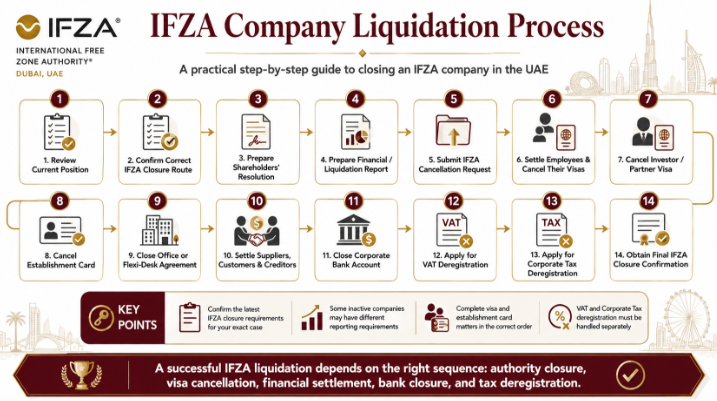
A standard IFZA company liquidation usually starts with a review of the company’s records and outstanding obligations. The shareholders then approve the closure and prepare the required resolution.
The company submits its cancellation request and supporting documents to IFZA, settles authority charges, cancels employee and investor visas, closes the establishment card, and clears its office or facility arrangement.
The owners must also settle suppliers, employees, customers, banks, and other parties. VAT and Corporate Tax registrations are handled separately through the Federal Tax Authority.
Once the required clearances and reports have been accepted, IFZA can complete the licence cancellation and issue final confirmation of closure.
The exact order and document list can vary according to the company’s activity, legal structure, visa status, financial history, tax registrations, and outstanding liabilities.
IFZA Company Liquidation Process
Step 1: Review the Company’s Current Position
Before submitting a cancellation request, the company should complete a full closure review.
This review should confirm whether the licence and establishment card are active or expired. It should also identify active visas, unpaid employee benefits, tax registrations, bank accounts, supplier balances, customer receivables, office agreements, subscriptions, insurance policies, customs records, and other business commitments.
The company should prepare a clear list of its assets and liabilities. Assets may include money in the bank, unpaid customer invoices, equipment, inventory, deposits, intellectual property, or refundable security amounts. Liabilities may include employee dues, supplier invoices, bank finance, customer refunds, tax, rent, and professional fees.
A complete review helps the shareholders understand what must be settled and how much the closure may cost.
Step 2: Confirm the Correct IFZA Closure Route
Not every IFZA company has the same closure history.
A dormant zero-visa company with no bank account or transactions may have a simpler position than an active trading company with employees, inventory, VAT registration, and several creditors.
The owners should request the current case-specific checklist before preparing documents. This is particularly important because publicly available specialist guidance is not fully consistent about whether every IFZA closure requires a complete liquidation audit or whether a simpler closure report may be accepted in some inactive-company cases.
Some current specialists describe a liquidation audit report as mandatory, while other closure guidance states that the report required can depend on the company’s activity and operating history.
The safest approach is not to assume that an audit is always required or never required. The company should confirm the latest IFZA requirement based on its exact legal and financial position.
Step 3: Prepare the Shareholders’ Resolution
The shareholders must formally approve the decision to close the company.
The resolution normally confirms the full legal name of the entity, its licence details, the decision to stop operations, and the authority given to a manager, shareholder, professional adviser, or liquidator to complete the closure.
All company details must match the IFZA licence and incorporation records. Incorrect names, outdated shareholder information, missing signatures, or unclear wording may cause delays.
Where a shareholder is a foreign corporate entity, additional parent-company documents may be needed. Documents signed outside the UAE may also require notarisation, legalisation, attestation, or certified translation.
More information is available in our guide to the documents and resolutions required for company liquidation.
Step 4: Prepare the Financial or Liquidation Report
IFZA may request a liquidation audit, financial closure report, statement of affairs, non-activity declaration, or another form of financial confirmation.
The report normally explains whether the company has assets, liabilities, trading activity, employees, outstanding receivables, or unpaid creditors. It may also confirm how the company’s balances have been settled.
An active company should make sure its accounting records are complete up to the closure date. Missing invoices, incomplete bank reconciliations, unrecorded shareholder transactions, and unclear loan balances can make the report harder to prepare.
A dormant company may still need to show that no business was conducted. The absence of revenue does not automatically mean that no records are required, particularly where the company opened a bank account, paid setup costs, obtained visas, or registered for tax.
Step 5: Submit the IFZA Cancellation Request
The company can then submit its licence cancellation or liquidation request through the relevant IFZA channel.
The initial submission may include the shareholder resolution, company licence, incorporation documents, shareholder identification, establishment card details, financial report, visa information, and proof relating to the office or flexi-desk.
IFZA may issue an invoice for the applicable cancellation services and request further documents based on the company’s file.
The company should check whether there are unpaid renewal charges, amendments, immigration costs, penalties, or other authority balances. These amounts may need to be paid before the closure can move forward.
Step 6: Settle Employees and Cancel Their Visas
Where the IFZA company sponsors employees, their employment and immigration matters must be completed properly.
The company should calculate unpaid salaries, leave balances, expenses, notice payments, end-of-service benefits, and any other contractual amounts. Evidence of settlement should be retained.
The sponsored residence visas must then be cancelled through the appropriate process. Entry permits or visa applications that were issued but not completed may also need formal cancellation.
Owners should check whether employees sponsor family members. Dependent visas may need to be dealt with before or in coordination with the cancellation of the main sponsor’s visa.
Visa cancellation should be planned carefully. Cancelling the main shareholder or manager’s authority too early can make it more difficult to sign documents, access the bank, approve payments, or respond to authority requests.
Step 7: Cancel the Investor or Partner Visa
After employee matters have been handled, the company can arrange cancellation of investor, partner, or manager visas linked to the entity.
The procedure and charges may differ depending on whether the visa holder is inside or outside the UAE. Expired visas, unused entry permits, overstay fines, and dependent sponsorship can also affect the process.
The company should check the person’s immigration position before submitting the request rather than assuming that a visa has automatically ended because the holder has been outside the country.
Official IFZA partner guidance confirms that cancellation and status-related charges can still apply in different visa scenarios, including expired or unused applications.
Step 8: Cancel the Establishment Card
The establishment card connects the company to immigration services and allows it to sponsor residence visas.
Once all relevant visas and immigration applications have been handled, the company can apply to cancel the establishment card. The correct order matters because an establishment card should not normally be closed while active sponsored visas remain unresolved.
Proof of establishment card cancellation may form part of the final IFZA closure file.
Step 9: Close the Office or Flexi-Desk Agreement
An IFZA company may use a flexi-desk, shared facility, office, or another approved workspace arrangement.
The company should review the agreement, settle any outstanding amounts, return access cards or equipment, and obtain a no-objection or clearance document where required.
Businesses using a separate office provider should not assume that cancelling the licence automatically ends the facility contract. Notice periods and unpaid invoices may continue unless the agreement is formally terminated.
Telecom, internet, software, storage, and insurance contracts should also be reviewed so that new invoices are not issued after the company stops operating.
Step 10: Settle Suppliers, Customers and Other Creditors
The company must deal with the parties to whom it owes money.
Supplier invoices should be checked and settled. Customer deposits may need to be refunded, and incomplete orders or service commitments should be resolved. Loans, credit cards, guarantees, and finance facilities must also be addressed.
Where the company has insufficient funds to pay its liabilities, the shareholders should obtain legal and insolvency advice. A company that cannot pay its debts may require a different process from a routine solvent voluntary closure.
Shareholders should not distribute the remaining bank balance or company property among themselves before employee, creditor, tax, and closure obligations have been settled.
Step 11: Close the Corporate Bank Account
The corporate bank account should usually remain open while the company is collecting receivables and paying its final liabilities.
Closing it too early can create problems if the company later needs to pay IFZA charges, tax balances, employees, suppliers, auditors, or professional advisers.
Once all expected transactions have been completed, the company can apply to close the account. The bank may ask for the licence cancellation request, shareholder resolution, identification documents, account cards, cheque books, or other supporting records.
Some banks may issue a closure confirmation or clearance letter. This document should be retained because it may be requested during liquidation or tax deregistration.
Read our complete UAE company bank account closure guide for more information.
Step 12: Apply for VAT Deregistration
IFZA licence cancellation does not automatically cancel a company’s VAT registration.
Where VAT deregistration is mandatory, the application must generally be submitted to the Federal Tax Authority within 20 business days from the date the deregistration obligation arises. The company may also need to file its final VAT return and settle outstanding tax.
Before applying, the business should check whether all VAT returns have been filed, penalties have been settled, and FTA information requests have been answered.
The company should also review the VAT treatment of remaining assets, inventory, unpaid invoices, bad debts, and amounts owed by or to shareholders.
The FTA may request evidence supporting the closure, such as the cancellation application, authority letter, shareholder resolution, financial statements, liquidation report, or proof that taxable activity has stopped.
Our VAT deregistration service in Dubai explains this process in more detail.
Step 13: Apply for Corporate Tax Deregistration
Corporate Tax registration must also be closed separately through EmaraTax.
A company that ceases its business through dissolution or liquidation must apply for Corporate Tax deregistration. The FTA has clarified that the application should be submitted within three months from the event that triggers deregistration.
Stopping the business during the first Corporate Tax period does not remove the company’s registration and filing responsibilities. The company may still need to register, file a return for the relevant period, settle tax, and provide supporting documents.
The FTA currently states that a completed Corporate Tax deregistration application may take up to 30 business days to process. More time may be needed when additional information is requested.
Corporate Tax should therefore be planned from the start rather than left until every other closure step has finished.
Step 14: Obtain Final IFZA Closure Confirmation
Once IFZA is satisfied that the required authority, visa, establishment card, facility, financial, and supporting matters have been completed, it can finalise the cancellation.
The company should obtain and safely retain the final licence cancellation or deregistration document.
This evidence may later be required by the bank, FTA, shareholders, auditors, foreign tax authorities, or another UAE licensing authority.
The owners should also retain the resolutions, financial reports, tax filings, visa cancellation records, bank statements, settlements, and authority receipts for the applicable record-retention period.
Documents Required for IFZA Company Liquidation
The exact checklist should be confirmed for the specific company. However, the following documents are commonly reported in current IFZA closure guidance.
| Document | Purpose |
| IFZA trade licence | Confirms the company and licence details |
| Certificate of incorporation | Confirms legal registration |
| Memorandum and articles | Confirms ownership and company rules |
| Shareholder resolution | Approves the IFZA company closure |
| Shareholder passports and Emirates IDs | Identifies the owners |
| Establishment card | Supports immigration closure |
| Visa and entry-permit records | Identifies sponsored immigration files |
| Financial statements | Shows the company’s financial history |
| Asset and liability statement | Identifies outstanding balances |
| Liquidation audit or closure report | Confirms the financial closing position |
| Office or flexi-desk clearance | Confirms the facility has been settled |
| Bank closure letter | Confirms the corporate account is closed |
| VAT deregistration evidence | Confirms the VAT account has been addressed |
| Corporate Tax deregistration records | Confirms the CT closure application |
| Power of attorney | Used where an authorised representative handles the process |
Additional documents may be required where the company has customs registration, regulated activities, corporate shareholders, unresolved disputes, or outstanding creditors.
How Much Does IFZA Company Liquidation Cost?
There is no single IFZA liquidation cost that applies to every company.
The total amount depends on the IFZA cancellation charges, number and type of visas, establishment card status, financial-report requirement, office agreement, tax position, unpaid fines, accounting condition, and professional assistance required.
Current market estimates vary considerably. Some providers estimate approximately AED 3,000 to AED 8,000 for a relatively small and straightforward IFZA closure, while others place broader cases at approximately AED 5,000 to AED 15,000 or more. These figures are third-party estimates rather than a compliance-focused IFZA quotation.
A simple dormant company with no visas, no tax registration, no bank account, and complete records may fall near the lower end of a market estimate. An active company with several visas, an audit requirement, outstanding rent, tax filings, bank finance, and unpaid liabilities can cost considerably more.
Main IFZA Liquidation Cost Areas
| Cost area | What affects it |
| IFZA licence cancellation | Current authority charges and licence status |
| Establishment card cancellation | Whether an active immigration file exists |
| Visa cancellation | Number of visas and whether holders are inside or outside the UAE |
| Financial or liquidation report | Volume and quality of accounting records |
| Office clearance | Notice period, rent and facility provider requirements |
| VAT deregistration | Outstanding returns, penalties and final adjustments |
| Corporate Tax deregistration | Registration, returns and supporting records |
| Bank closure | Loans, cards, guarantees and account balances |
| Professional support | Complexity and amount of coordination required |
| Outstanding fines | Late renewal, immigration, tax or authority penalties |
Before beginning the process, request an itemised quotation that separates authority fees, visa costs, audit charges, tax support, professional fees, and outstanding liabilities.
Our guide to the real cost of company liquidation in Dubai provides a wider cost breakdown.
How Long Does IFZA Company Liquidation Take?
A straightforward IFZA company closure may take approximately four to eight weeks, but this is only a practical estimate and not a compliance-focused authority timeframe.
Current specialist guidance commonly places IFZA closure at around six to eight weeks for a standard case. Dormant companies may sometimes move faster, while active companies with visas, audit work, tax matters, or outstanding liabilities can take longer.
The timeline may be extended by expired company documents, missing accounts, overseas shareholder signatures, employee disputes, immigration issues, bank loans, tax penalties, or incomplete office clearance.
FTA processing should also be considered separately. Corporate Tax deregistration can take up to 30 business days after a complete application is received, and additional information requests can extend this period.
You can also read our guide explaining how long it takes to liquidate a company in Dubai.
Can an Inactive IFZA Company Be Closed More Easily?
An inactive company may have a simpler financial position, but it still needs formal closure.
The owners should show whether the company had any bank transactions, setup expenses, visa costs, shareholder funding, subscriptions, or tax registrations. A company can have no sales and still have financial records that must be explained.
Where the business never traded, IFZA may ask for a non-activity declaration or another form of financial confirmation rather than a large set of trading records. However, the exact requirement must be confirmed for the company’s case.
An inactive licence should not simply be ignored. It can remain in government and tax records and may continue to create compliance problems.
Read more about the risks in our guide to leaving a company inactive in the UAE without closing it.
Can You Close an IFZA Company Remotely?
Some IFZA closure work may be handled remotely through an authorised representative or power of attorney.
Remote closure depends on where the shareholders are located, whether original signatures are required, the status of sponsored visas, bank requirements, and whether any documents need UAE or foreign attestation.
Bank closure can be one of the more difficult stages to complete remotely because banks apply their own identification and signing procedures.
The shareholders should confirm remote-handling requirements before preparing a power of attorney. A general authorisation may not be accepted if it does not include the specific powers needed for company, immigration, bank, and tax closure.
Common IFZA Company Closure Mistakes
Waiting Until After the Licence Expires
An expired licence may create fines and restrictions that must be cleared before cancellation. Starting before expiry usually gives the company more control over cost and timing.
Assuming a Liquidation Report Is Not Required
Requirements can depend on the company’s activity and financial history. Obtain the current checklist before appointing an auditor or submitting the application.
Cancelling the Main Visa Too Early
The shareholder or manager may still need to sign forms, access the bank, approve payments, or respond to authority requests.
Closing the Bank Account Before Final Payments
The company may still need to pay employees, suppliers, tax, professional fees, and authority charges.
Ignoring Corporate Tax
Even a company that never earned income may still have Corporate Tax registration and filing responsibilities.
Assuming VAT Ends Automatically
VAT deregistration is a separate FTA process and has its own application deadline.
Forgetting Dependent Visas
Family visas connected to an investor or employee may need to be cancelled or transferred before the sponsor’s immigration file is closed.
Leaving the Office Contract Open
Licence cancellation does not necessarily terminate a separate workspace or business-centre agreement.
Taking the Remaining Company Money Too Early
Shareholders should only receive the final balance after employee, creditor, tax, authority, and closure costs have been addressed.
For more practical guidance, read our article on the mistakes to avoid when closing a free-zone company.
Practical Example of IFZA Company Liquidation
Consider an IFZA consultancy company with one shareholder, one investor visa, a corporate bank account, a flexi-desk, Corporate Tax registration, and no employees.
The shareholder decides to close the company before its next renewal date. A review shows that the company has no supplier debts but still has money in its bank account, unpaid professional invoices, and an active investor visa.
The shareholder signs the closure resolution and confirms the financial-report requirement. The IFZA cancellation request is then submitted and the applicable charges are paid.
The company settles its final invoices, completes the investor-visa and establishment-card cancellation, and clears the flexi-desk agreement. The bank account remains open until all payments have been processed.
The company then closes the bank account and submits its Corporate Tax deregistration application with the available closure evidence. Once IFZA accepts the required documents and clearances, the company receives final cancellation confirmation.
This example shows why the closure steps must be planned in the correct order. Cancelling the bank account or the shareholder’s authority too early can make the remaining work more difficult.
How Capital Closure Supports IFZA Company Liquidation
An IFZA company liquidation can involve IFZA, immigration, an office provider, a bank, an auditor, the Federal Tax Authority, employees, suppliers, and other parties.
When each task is handled separately, important dependencies may be missed. For example, the bank may require the shareholder’s signature, while the visa team may be preparing to cancel the shareholder’s immigration status.
Capital Closure provides advisory, accounting-record review and documentation-preparation support for company closure requirements. We help identify applicable requirements and prepare a company-specific checklist. Relevant authorities process official applications and issue their own decisions and certificates.
We also assist businesses in other jurisdictions through our free-zone company liquidation services in Dubai.
Our objective is to identify risks early, explain the likely IFZA liquidation cost, and help shareholders complete the closure without leaving open authority, tax, visa, or banking matters.
Conclusion
An IFZA company liquidation should be completed through a planned and properly coordinated process. Simply stopping business activity or allowing the licence to expire does not formally close the company and may lead to additional fines, tax obligations, visa issues, banking requests, and other compliance problems.
The exact IFZA company closure requirements depend on the company’s activity, licence status, number of visas, financial records, tax registrations, office arrangement, bank account, and outstanding liabilities. A dormant company with no employees or debts may have a simpler closure, while an active company with visas, creditors, tax filings, and incomplete accounts may require more time and professional support.
Starting early helps shareholders control the IFZA liquidation cost, prepare the correct documents, settle obligations in the right order, and avoid unnecessary delays. The company should also keep the final licence cancellation, tax deregistration records, visa cancellation documents, bank closure evidence, and financial reports as proof that the closure was completed correctly.
Frequently Asked Questions
Is a liquidator mandatory for IFZA company liquidation?
The financial document required can depend on the company’s legal and operating position. Current specialist sources are not fully consistent, with some describing a liquidation audit as mandatory and others referring to a simpler report for certain inactive cases. Confirm the current case-specific IFZA checklist before proceeding.
How much does IFZA company liquidation cost?
Current market estimates commonly range from approximately AED 3,000 to AED 15,000 or more. The actual cost depends on IFZA charges, visas, audit or reporting requirements, tax work, facility clearance, professional support, fines, and outstanding liabilities.
How long does IFZA company closure take?
A straightforward case may take around four to eight weeks. Missing documents, several visas, tax matters, bank finance, expired licences, or unpaid obligations can extend the timeline.
Can I close an IFZA company with an expired licence?
An expired IFZA licence can still be cancelled, but applicable fines and outstanding amounts generally need to be cleared before formal cancellation or liquidation.
Can an IFZA company with debts be liquidated?
The company’s liabilities must be identified and handled. Where the business cannot pay its debts, the shareholders should obtain legal and insolvency advice rather than treating the closure as a routine solvent cancellation.
Do I need to cancel all visas before closing the company?
Sponsored employee, investor, partner, and relevant dependent visas must be reviewed and handled before the company’s immigration and establishment-card files can be fully closed.
Does cancelling the IFZA licence automatically cancel VAT?
No. VAT deregistration is completed separately through the FTA’s EmaraTax platform. Where deregistration is mandatory, the application generally has to be submitted within 20 business days from the date the obligation arises.