Running a business in the UAE is not always easy. When it is time to exit, many business owners feel confused and unsure about what to do next. Choosing the wrong option can lead to money loss, legal problems, or delays, which can make the situation even more stressful.
If you are thinking about selling or liquidating a company in the UAE, this guide will explain both options in a simple way. It will help you understand what each choice means, so you can decide what is best for your business and move forward with confidence.
Understanding Business Exit Options in UAE
Why business owners need an exit strategy
Every business owner eventually faces the need to exit, whether due to financial challenges, market changes, or personal goals. Having a clear exit strategy ensures that you minimize risks and maximize returns while staying compliant with UAE laws.
Without proper planning, business owners may face penalties, unresolved liabilities, or loss of potential value. That is why understanding your options early helps in making informed and strategic decisions.
Overview of selling vs liquidating a company in UAE
In simple terms, selling a company means transferring ownership to another party, while liquidation involves closing the business completely. Both options have different legal, financial, and operational implications.
Choosing between these depends on your company’s financial health, market demand, and long term goals. Each path offers unique benefits and challenges that must be evaluated carefully.
What Does It Mean to Sell a Company in UAE
Definition of business sale
Selling a company involves transferring ownership, assets, and operations to a new buyer. The business continues to operate under new management, often retaining employees, clients, and brand value.
This option is typically suitable for businesses that are still profitable or have strong market potential. It allows owners to recover their investment and sometimes make a profit.
How the selling process works in UAE?
The process usually starts with business valuation, followed by finding potential buyers. Once a buyer is identified, negotiations take place, and legal agreements are drafted.
After finalizing the deal, ownership is officially transferred through relevant authorities in the UAE. This process requires proper documentation and compliance with legal procedures.
When selling a company a good option?
Selling is ideal when your business is financially stable and has growth potential. It is also beneficial when there is demand in the market for your type of business.
If you want to exit while preserving business continuity and gaining financial returns, selling is often the preferred route.
What Does It Mean to Liquidate a Company in UAE
Definition of company liquidation
Liquidation is the process of closing a business permanently by settling its debts, selling assets, and removing it from official records. Once completed, the company ceases to exist.
This option is commonly chosen when a business is no longer viable or cannot find a buyer.
Types of liquidation in UAE
Voluntary liquidation
Voluntary liquidation occurs when business owners decide to close the company on their own. This usually happens when the business is no longer profitable or the owners want to move on.
It is a structured process that involves appointing a liquidator and settling all obligations.
Compulsory liquidation
Compulsory liquidation is initiated by a court order, usually when a company fails to pay its debts. This is more complex and involves legal proceedings.
It often results in stricter oversight and can impact the reputation of the business owners.
When liquidation is the right choice
Liquidation is suitable when the business is running at a loss, has significant debts, or lacks buyer interest. It provides a clean and legal closure.
It ensures that all liabilities are settled properly, reducing future legal risks.
Key Differences Between Selling and Liquidating a Company
Ownership transfer vs business closure
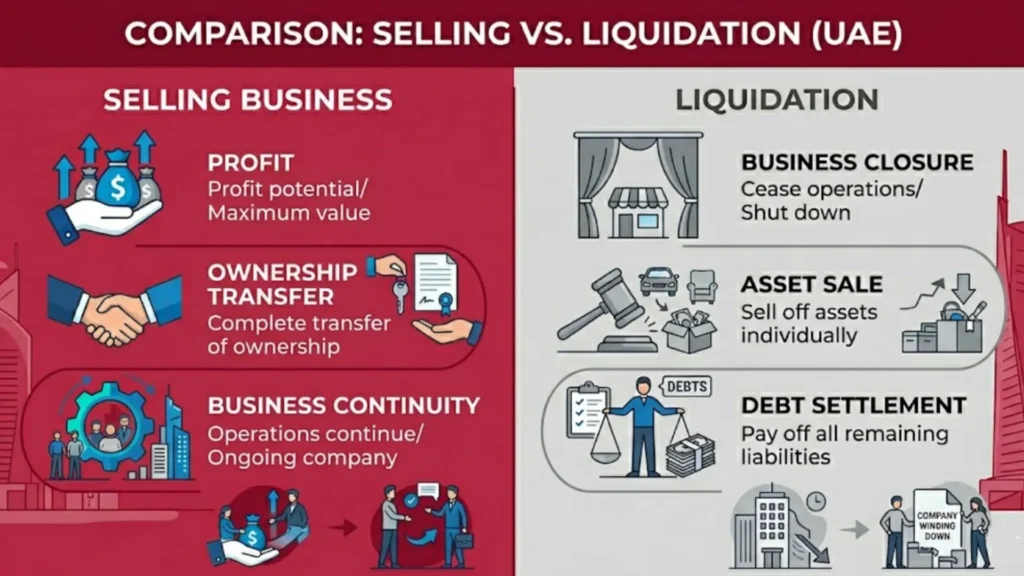
Selling transfers ownership to a new party, allowing the business to continue operating. Liquidation, on the other hand, results in complete closure.
This is the most fundamental difference between the two options.
Financial outcomes and returns
Selling can generate profit or at least recover investment. Liquidation usually results in limited financial returns after settling debts and expenses.
The financial impact depends heavily on the condition of the business.
Legal and regulatory implications
Selling involves ownership transfer agreements and regulatory approvals. Liquidation requires legal procedures, clearances, and final deregistration.
Both require compliance, but liquidation tends to be more document-heavy.
Time required for each process
Selling a business may take longer due to buyer search and negotiations. Liquidation has a structured timeline but can still take several months.
The duration varies based on complexity and legal requirements.
Advantages of Selling a Company in UAE
Potential for profit and business continuity
Selling allows you to earn from the value you have built over time. The business continues to operate, benefiting employees and customers.
This makes it a financially rewarding option in many cases.
Brand value and goodwill transfer
A well established brand can attract buyers and increase the sale price. Goodwill becomes a valuable asset during negotiations.
This advantage is not available in liquidation.
Less operational disruption
Since the business continues under new ownership, there is minimal disruption to operations. Employees and clients experience continuity.
This helps maintain the company’s reputation in the market.
Disadvantages of Selling a Company
Difficulty finding buyers
Finding the right buyer can be challenging, especially in competitive markets. It may take significant time and effort.
This can delay your exit plan.
Valuation challenges
Determining the correct value of a business is complex. Overpricing may scare buyers, while underpricing leads to losses.
Professional valuation is often required.
Legal risks after sale
Improper agreements can lead to future disputes or liabilities. It is essential to ensure all legal aspects are covered.
This requires expert guidance and documentation.
Advantages of Company Liquidation in UAE
Clear closure of liabilities
Liquidation ensures that all debts and obligations are settled before closing the business. This reduces future risks.
It provides peace of mind to business owners.
Simplified exit when no buyers are available
If no buyers are interested, liquidation becomes the most practical option. It allows you to exit without prolonged delays.
This is common for struggling businesses.
Legal closure and compliance
Once the process is complete, the company is officially removed from records. This ensures full compliance with UAE regulations.
It protects owners from future legal issues.
Disadvantages of Liquidating a Company
Loss of business value
Unlike selling, liquidation does not allow you to benefit from the business’s goodwill or brand value.
Most assets are sold at lower prices.
Costs involved in liquidation
Liquidation involves fees for legal processes, approvals, and liquidators. These costs can add up.
They reduce the overall financial return.
Time consuming legal process
The process requires multiple approvals and clearances. It can take several months to complete.
Delays can occur if documentation is incomplete.
Cost Comparison Sell vs Company Liqudation UAE
Costs involved in selling a business
Selling involves valuation fees, legal charges, and brokerage costs. These vary depending on the complexity of the deal.
However, these costs are often offset by the sale price.
Costs involved in liquidation
Liquidation includes government fees, liquidator charges, and administrative expenses. These are fixed and unavoidable.
They must be paid regardless of business performance.
Hidden expenses to consider
Both options may include hidden costs such as penalties, unpaid dues, or documentation charges.
Careful financial planning is essential to avoid surprises.
Timeline Comparison: Sell vs Liquidate Company in the UAE
How long it takes to sell a company
Selling a business can take several months, depending on buyer availability and negotiation time.
Complex deals may take longer to finalize.
How long liquidation takes in UAE
Liquidation typically takes between three to six months. The timeline depends on approvals and settlement of liabilities.
Proper documentation can speed up the process.
Factors to Consider Before Choosing the Right Option
Financial health of the company
A profitable business is better suited for selling, while a loss making one may require liquidation.
Financial analysis is the first step in decision making.
Market demand and buyer availability
If there is strong demand for your business type, selling becomes easier and more profitable.
Low demand may push you toward liquidation.
Legal obligations and debts
High liabilities may make selling difficult. Liquidation helps in settling debts legally.
Understanding your obligations is crucial.
Long term business goals
Your future plans also matter. If you want quick closure, liquidation is suitable. If you seek returns, selling is better.
Align your decision with your goals.
Real-Life Example: Sell vs Liquidate Decision
Case study of a profitable business sale
A retail company in Dubai with steady profits found a buyer within three months. The owner sold the business at a good valuation and exited smoothly.
This demonstrates the benefits of selling when the business is performing well.
Case study of a company liquidation
A small trading company facing losses and debts opted for liquidation. The process helped clear liabilities and legally close the business.
This shows how liquidation can be a practical solution in difficult situations.
Which Option Is Better: Sell or Liquidate a Company in the UAE?
Decision making checklist
- Consider these key points before deciding
- Financial condition of your business
- Availability of potential buyers
- Outstanding debts and liabilities
- Time available for exit
- Desired financial outcome
Evaluating these factors will guide you toward the right choice.
Expert recommendation based on scenarios
If your business is profitable and has demand, selling is usually the better option. It allows you to maximize value and exit smoothly.
If your business is struggling or has no buyers, liquidation provides a clean and compliant closure.
How Professional Services Can Help You Exit Smoothly
Role of business consultants in UAE
Professional consultants guide you through legal procedures, documentation, and decision making. They help avoid costly mistakes.
Their expertise ensures a smooth and efficient process.
Why choose expert liquidation or sale support
Working with experts saves time and reduces risks. They handle complex tasks while you focus on your next steps.
For reliable support, you can explore the services of Capital Closure, including company restructuring before exit services in Dubai, for advisory support with business-exit preparation.
Conclusion
Choosing between selling and liquidating a company in the UAE depends on your business condition, goals, and market situation. Selling offers financial returns and continuity, while liquidation ensures a clean and legal closure when continuation is not possible.
If you are unsure which option is right for you, professional guidance can make all the difference. Visit Capital Closure today to get expert assistance and make the best decision for your business exit.