Missing one document can send your DMCC liquidation application back for correction. The paperwork also changes based on your shareholder structure, company type, business activity, and winding-up route. DMCC company liquidation documents can include shareholder resolutions, liquidator documents, company records, identity documents, clearances, and regulatory approvals.
Capital Closure provides independent company-closure advisory, accounting-record review and documentation-preparation support. We help identify relevant requirements and organize a company-specific checklist. The relevant authorities process applications, decide approvals and issue official documents.
The important point is that not every DMCC company needs the same documents. A company with individual shareholders follows different paperwork from one with a corporate shareholder. Branches, joint ventures, regulated businesses, trading companies, and solvent companies may also need additional documents.
What Documents Do You Need to Liquidate a DMCC Company? Quick Answer

Most DMCC companies need a combination of corporate, legal, identity, liquidator, financial, and clearance documents.
The exact DMCC liquidation documents depend on the company’s structure and winding-up route.
| Document | Who needs it? | Original or copy? | Main requirement |
| Shareholders’ Resolution | Companies with individual shareholders | As required | Approves closure or winding-up |
| Board Resolution | Corporate shareholder, subsidiary, or branch | As required | Authorizes winding-up |
| Certificate of Incumbency | Corporate shareholder or parent company | Original where required | Must be recent |
| Liquidator Appointment | DMCC companies | Required | Appoints an eligible liquidator |
| Liquidator Confirmation | Companies with an appointed liquidator | Original where required | Confirms the appointment |
| Declaration of Solvency | Solvent or summary winding-up | Original | Signed by directors |
| Power of Attorney | If a representative handles the process | Original where required | Must authorize winding-up |
| Passport documents | Relevant shareholders, directors, or representatives | As required | Confirms identity |
| DMCC Trade License | Company | As required | Supports license termination |
| MOA/AOA | Applicable companies | Original where required | Company constitutional records |
| Certificate of Registration | If originally issued | Original where required | Registration record |
| Share Certificates | If originally issued | Original where required | Ownership records |
| Clearance letters/NOCs | Where applicable | As required | Confirms obligations are cleared |
| Liquidation Report | DMCC companies requiring liquidation | Original | Issued by the liquidator |
DMCC’s official winding-up guidance states that it may request additional information or documents during the application. Therefore, this table should be treated as a starting point rather than a universal checklist.
DMCC Liquidation Documents Checklist
Your DMCC liquidation document checklist should cover several groups.
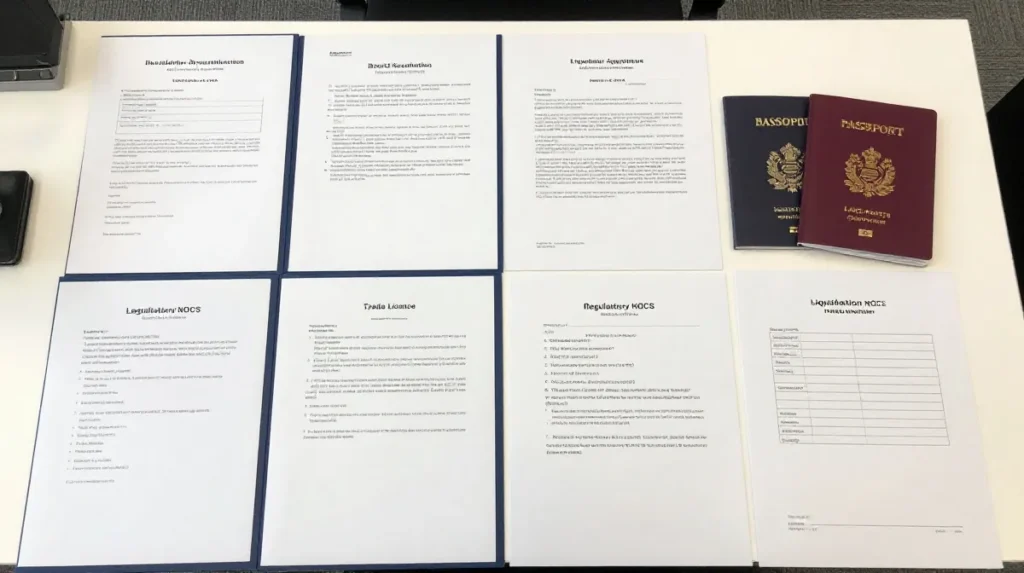
These usually include:
- Corporate and shareholder documents
- Liquidator documents
- Solvency documents
- Company legal records
- Identity and authorization documents
- Bank and other clearance documents
- Customs and regulatory NOCs
- Visa, access card, and permit cancellation records
- Financial and liquidation reports
- Special documents based on company structure
DMCC separates several requirements based on the type of company and winding-up procedure. That distinction matters because submitting unnecessary documents wastes time, while missing a required document can delay the application.
Corporate and Shareholder Documents
The first group contains documents that prove the shareholders or parent company have approved the closure.
Shareholders’ Resolution for Liquidation
A shareholders’ resolution for liquidation records the decision to wind up the company.
For a company with individual shareholders, DMCC’s guidance identifies a Shareholder’s Resolution as a required document. The resolution should clearly authorize the company’s winding-up or closure and deal with the appointment of a liquidator where applicable.
Depending on the company’s structure, you may see this document described as a:
- Shareholder resolution for company closure
- Shareholders’ resolution for winding up
- Company winding-up resolution
- Company dissolution resolution
The document should match the company’s actual shareholder structure. Errors in shareholder names, company details, authority, or signatures can lead to corrections.
Board Resolution From a Corporate Shareholder or Parent Company
A parent company board resolution becomes important when a corporate entity owns the DMCC company or when a parent company controls a branch.
The resolution confirms that the corporate shareholder or parent company has authorized the winding-up.
DMCC’s guidance sets out signing and authentication requirements for applicable corporate or parent company resolutions. Depending on where and how the document is executed, it may need an authorized signatory, notarization, or legalization.
This document may also be referred to as a corporate shareholder resolution or parent company resolution.
For joint ventures, DMCC identifies a Joint Shareholder’s Resolution as an additional requirement. All relevant shareholders must follow the applicable signing requirements.
Certificate of Incumbency
A Certificate of Incumbency proves who currently holds authority within the corporate shareholder or parent company.
This document matters when a corporate entity owns the DMCC company or when a branch requires parent-company documentation.
DMCC’s guidance states that the Certificate of Incumbency should be recent, with the relevant attestation date within one year. Notarization or legalization may apply, although DMCC also describes circumstances where online verification can be used.
If your company has a corporate shareholder, check this document early. An outdated certificate can create avoidable delays.
Liquidator Documents
A DMCC company liquidation normally requires a liquidator. The liquidator handles the financial and closing work needed to complete the winding-up.
Appointment of Liquidator
The appointment of a liquidator is a key part of the DMCC company closure process.
DMCC’s official guidance states that a liquidator appointment applies to companies. It also states that the appointed liquidator must be an auditing firm registered and licensed by the competent UAE authority.
You may encounter related terms such as:
- DMCC approved liquidator
- DMCC approved auditor
- Liquidator appointment letter
- Resolution appointing liquidator
- Liquidator appointment resolution
- Registered liquidator in UAE
- UAE licensed auditing firm
The appointment document should clearly identify the company and the appointed liquidator.
Do not confuse the appointment with the confirmation of appointment. They are related documents, but they serve different purposes.
Confirmation of Appointed Liquidator
After the liquidator accepts the appointment, DMCC may require a Confirmation of Appointed Liquidator.
The official DMCC guidance identifies this confirmation as an original document where applicable.
It confirms that the appointed liquidator accepts the role and can carry out the required liquidation work.
Final Liquidation Report
The final liquidation report is one of the most important documents at the end of the process.
DMCC’s guidance requires a liquidation report for companies. The report comes from the appointed liquidator, and the original must be submitted where required.
Depending on the context, you may also hear terms such as:
- Liquidator report
- Final liquidation report
- Liquidation audit report
- Audited financial statements
- Final financial statements
- Statement of affairs
- Liquidator’s statement
The report helps demonstrate that the company’s financial affairs have been reviewed and dealt with before final closure.

Declaration of Solvency: When Is It Required?
A Declaration of Solvency does not apply to every DMCC winding-up situation.
DMCC’s guidance identifies it for solvent winding-up and summary winding-up.
Under the current DMCC Company Regulations, directors or the applicable majority of directors must sign the declaration for a solvent winding-up. The declaration addresses whether the company can pay its liabilities and must be made within the specified period before the winding-up resolution or on the same date before the resolution is passed.
In simple terms, the declaration tells DMCC that the directors consider the company’s financial affairs capable of being completed under the applicable solvent procedure.
This makes the Declaration of Solvency DMCC requirement especially important when choosing between summary, solvent, and insolvent voluntary winding-up.
If the company’s financial position does not support the declared solvent route, the liquidation may need to follow an insolvency procedure instead.
Company Legal Documents You Must Submit
Your DMCC company also has legal records that may need to be returned or submitted during closure.
DMCC Trade License
The DMCC trade license identifies the company’s licensed activities and legal status within the free zone.
The original license may need to be returned where applicable. Requirements can differ depending on the records issued to the company.
You may also see related terms such as:
- Original trade license
- Company license
- License cancellation documents
- License termination documents
- DMCC license termination documents
Do not assume that an expired license means the company has automatically completed its legal closure. License status and company deregistration are separate matters.
MOA and AOA
The Memorandum of Association and Articles of Association contain important constitutional information about the company.
DMCC’s guidance distinguishes requirements based on the company’s registration or licensing date. Companies registered or licensed before 2 January 2020 may need their original MOA and AOA. Companies registered or licensed after that date may have different AOA requirements.
Therefore, do not use a generic MOA/AOA checklist without checking the company’s registration history.
Certificate of Registration
DMCC may require the original Certificate of Registration if one was issued.
If the company received an electronic certificate instead, the treatment can differ. DMCC’s guidance specifically distinguishes an original Certificate of Registration from an e-Certificate.
Share Certificates
Share certificates document the company’s ownership.
Where original share certificates were issued, DMCC’s guidance identifies them among the documents that may need to be submitted. The requirement can include all original certificates issued for the shareholders.
An e-share certificate should not automatically be treated the same as an original physical certificate. Check the company’s actual records and DMCC’s current submission instructions.
Personnel Secondment Agreement
Some companies also have a Personnel Secondment Agreement.
DMCC identifies this document where an original was issued.
This is easy to overlook because it does not apply to every company. Check your original company records before submitting the final document package.
Identity and Authorization Documents
DMCC may require identity and authority documents for shareholders, directors, authorized signatories, or representatives.
1. Shareholder Passport Copies
A shareholder passport copy may form part of the company’s closure documents, depending on its structure and application requirements.
Make sure the passport details match the company records.
2. Director Passport Copies
The same principle applies to director identification.
A director passport copy can be needed to support resolutions, declarations, or other company records.
3. Authorized Signatory Passport
Where an authorized signatory executes corporate documents, the relevant authorized signatory passport may be required.
The signatory’s authority should also match the company’s official records.
4. Emirates ID
An Emirates ID can be relevant when the shareholder, director, signatory, or representative holds UAE identification.
The exact identity documents required depend on the person involved and the service application.
5. Power of Attorney
A power of attorney becomes important when someone handles the liquidation on behalf of a shareholder, director, or company.
DMCC’s guidance states that the POA must specifically authorize the winding-up of the company or the removal of a branch. It also provides different verification requirements for POAs issued inside and outside the UAE.
This means a general POA may not be enough.
Depending on where it was issued, you may need a:
- Company POA
- Liquidation Power of Attorney
- Notarized Power of Attorney
- Legalized Power of Attorney
POA Holder Passport
If a representative acts under a POA, DMCC identifies the passport of the POA holder as an applicable document.
The official guidance also states that an original passport may be required for verification.
Clearance Certificates and NOCs Required for DMCC Liquidation
Document submission alone does not complete a company liquidation.
You may also need evidence that the company has cleared its outstanding obligations.
Bank Clearance
A company should address its bank relationship before final closure.
Depending on the situation, this may include bank closure evidence, a nil-balance confirmation, or other proof that the company has settled its banking obligations.
The exact document depends on the bank and the company’s account status.
Telecom Clearance
If the company has business telecom services, settle the account and obtain the relevant closure or clearance evidence.
This may include services from providers such as Etisalat or du.
The purpose is simple: show that the company has no remaining telecom liability.
DEWA or Utility Clearance
Companies with physical premises may also need to close utility accounts.
Where applicable, obtain final bills and evidence of settlement for services such as electricity and water.
Landlord or Business Centre Clearance
A company with a physical office may need a landlord clearance confirming that the lease has ended and no outstanding liability remains.
Flexi-desk companies may follow a different process through the relevant business centre.
DMCC’s termination guidance also indicates that lease termination matters even when a lease has expired.
Dubai Customs NOC
This requirement is especially important for companies holding a trading license.
DMCC’s published termination guidance identifies a Customs NOC for Trading License holders.
Therefore, a trading company should not assume that its general company closure documents are enough.
Third-Party Regulatory NOC
Regulated businesses may need clearance from the authority that regulates their activity.
DMCC specifically identifies an NOC from a third-party regulator where applicable.
The exact authority depends on the licensed activity.
CPAM NOC
A CPAM NOC can apply to certain companies that own property within specified DMCC properties.
DMCC’s termination guidance identifies this requirement for companies owning property in certain Almas, Au, Ag, Jewellery, and Gemplex Tower properties.
This is one reason a standard “15-document liquidation checklist” can be misleading. Property ownership can change the required paperwork.
Visa, PIC, TAC and Establishment Card Documents
Immigration records also need attention before the company reaches final closure.
If the company has active visas, access cards, or permits, these normally need cancellation as part of the closure process.
This can include:
- Employee visa cancellation
- Shareholder or investor visa cancellation
- Permanent Identity Card (PIC)
- Temporary Access Card (TAC)
- Establishment Card
- Immigration-related closure records
DMCC’s official winding-up guidance states that active visas, access cards, and permits should be cancelled where applicable before the final stages of the winding-up process.
If the company has no employees or active visas, those particular cancellation steps may not apply.
However, you should still check the company’s immigration records. “No employees” does not automatically mean “no immigration file.”
Documents for Different DMCC Company Structures
The easiest way to understand DMCC company closure requirements is to match documents to the company’s actual situation.
| Company situation | Potential additional document |
| Individual shareholders | Shareholders’ Resolution |
| Corporate shareholder | Corporate/parent Board Resolution |
| Subsidiary | Parent company documents |
| Branch | Parent company documents and applicable undertaking |
| Joint venture | Joint Shareholder’s Resolution |
| POA representative | POA and POA holder passport |
| Solvent winding-up | Declaration of Solvency |
| Summary winding-up | Declaration of Solvency |
| Insolvent voluntary winding-up | Liquidation Committee documents |
| Trading or industrial license | Customs clearance |
| Regulated activity | Third-party regulator NOC |
| Physical office | Landlord clearance |
| Applicable property-owning company | CPAM NOC |
Branches also differ from companies in an important way. DMCC’s guidance states that a liquidator is mandatory for companies but not required for branches. Instead, a branch may require an undertaking from the parent company confirming matters such as solvency and future claims.
That distinction can save a branch owner from following the wrong checklist.
DMCC Liquidation Documents for a Dormant Company
A dormant company should not be treated as a company with no paperwork.
Even if the business never traded, you still need to determine its current license status, shareholder structure, visa position, bank status, and outstanding obligations.
A dormant DMCC company may still require the appropriate winding-up documents and, where applicable, a liquidator and liquidation report.
The fact that a company has no recent business activity does not automatically remove its legal closure requirements.
You should also check whether the company has:
- An active or expired license
- Active visas
- A bank account
- Outstanding government fees
- Tax obligations
- Employees
- Lease commitments
- Customs registration
- Regulatory approvals
- Company assets or liabilities
The right approach is to review the company’s actual records first. Do not assume that a dormant company needs fewer documents simply because it stopped trading.
What Happens If You Are Missing a DMCC Liquidation Document?
DMCC may request additional information or documents during the application process.
Its official guidance states that DMCC can ask for additional information and may require documents to be re-uploaded.
Common problems include an incorrect resolution, outdated corporate documents, missing originals, incomplete authorization, unsuitable POA wording, or missing clearance.
Lost documents can also require additional steps.
DMCC’s termination guidance provides specific routes for certain lost company documents. For example, an undertaking and applicable fees may be required where certain original legal documents are unavailable. A lost Establishment Card can involve additional requirements, including an undertaking, applicable fees, and a police report.
The safest approach is to identify missing documents before submitting the application.
DMCC Liquidation Document Checklist — Before You Submit
Use this checklist to review your file before starting the final submission.
1. Corporate documents
Check your shareholders’ resolution, corporate shareholder or parent board resolution, Certificate of Incumbency, and any joint shareholder resolution that applies.
2. Shareholder and identity documents
Check passport copies, Emirates IDs where applicable, authorized signatory documents, POA documents, and the POA holder’s passport.
3. Liquidator documents
Check the liquidator appointment, confirmation of appointment, and documents required from the appointed auditing firm.
4. Company legal documents
Check the DMCC trade license, MOA, AOA, Certificate of Registration, share certificates, and Personnel Secondment Agreement where applicable.
5. Financial documents
Prepare the financial records needed by the liquidator. These can include final financial statements, bank records, outstanding liability information, and other records needed to prepare the liquidation report.
6. Clearances and NOCs
Check bank, telecom, utility, landlord, customs, third-party regulator, and CPAM requirements where applicable.
7. Visa and immigration documents
Confirm the status of employee and shareholder visas, PICs, TACs, permits, and the Establishment Card where applicable.
8. Special-case documents
Review additional requirements for branches, corporate shareholders, joint ventures, regulated businesses, trading companies, property owners, and insolvent companies.
Not every company needs every document. Your final checklist depends on your company structure, license type, shareholder structure, winding-up route, and regulatory activity.
What Happens After You Submit the Documents?
The document checklist is only one part of the DMCC closure process.
The published DMCC process generally involves submitting the required information through the Member Portal, completing the applicable document review, submitting originals where required, cancelling active visas and access records, completing publication requirements, and providing the liquidator’s final report.
The process then moves toward license termination and final deregistration.
DMCC’s published termination guidance describes two publication stages. The License Termination publication runs for 14 calendar days, followed by a separate 14-calendar-day publication period for deregistration. The final termination and de-registration letters are issued after the applicable requirements are completed.
This point is worth highlighting because different UAE liquidation procedures can have different publication rules.
For DMCC, do not automatically apply a mainland “45-day public notice” rule to the free-zone procedure. Always check the current DMCC instructions for the specific service.
How Long Does DMCC Company Liquidation Take?
DMCC’s published termination guidance states a timeframe of approximately 45–60 days after completion of the requirements, including the publication periods.
That is not a compliance-focused completion date.
Several issues can extend the process, including:
- Missing documents
- Incorrect resolutions
- Delayed bank closure
- Outstanding liabilities
- Visa or immigration issues
- Landlord disputes
- Customs clearance
- Regulatory NOCs
- Missing original documents
- Complex shareholder structures
- Problems with the liquidator’s report
The faster you resolve these issues, the less likely they are to interrupt the application.
DMCC Liquidation Documents vs. DMCC License Cancellation Documents
These terms often appear together, but they do not mean exactly the same thing.
Liquidation refers to the process of closing the company’s affairs, dealing with assets and liabilities, and completing the required winding-up work.
Winding up describes the formal process used to bring the company’s affairs to an end.
License termination concerns the termination of the company’s DMCC license.
Deregistration removes the company from the relevant DMCC company register after the required closure steps are completed.
Dissolution refers to the final legal end of the company after the winding-up process.
This distinction matters because cancelling or terminating a license does not necessarily mean every part of the company’s legal closure has already been completed.
Your DMCC company termination documents and DMCC company deregistration documents should therefore be prepared as part of the complete closure process.
Get Your DMCC Liquidation Document Checklist Reviewed
Not sure which documents apply to your company?
Your checklist can change because of one small detail, such as a corporate shareholder, active visa, trading license, regulated activity, physical office, or overseas representative.
Capital Closure can review your shareholder structure, license type, visa status, business activity, and existing paperwork to identify the documents required for your specific DMCC closure.
A document review before submission can help you spot missing resolutions, outdated corporate records, incorrect POA wording, missing clearances, or other issues before they slow down the process.
Source and Accuracy Note
This guide is based primarily on DMCC’s published Guidance Notes – Company Winding-Up and Removal of Branches, DMCC company termination guidance, and the current DMCC Company Regulations. Requirements can vary by company structure, license type, financial position, and business activity.
DMCC may also request additional information during an application. Always confirm the latest requirements before submitting your final documents.
Last updated: September 2026
Frequently Asked Questions
What documents are required for DMCC company liquidation?
Common documents include the relevant shareholder or board resolution, liquidator appointment, company legal documents, identity documents, applicable clearances and NOCs, and the final liquidation report. Additional documents depend on the company structure and winding-up route.
Do I need a shareholders’ resolution to liquidate a DMCC company?
For a company with individual shareholders, DMCC’s guidance identifies a Shareholder’s Resolution for winding-up. Corporate shareholders and branches may instead require a parent or corporate board resolution.
Does a DMCC company need a liquidator?
DMCC’s winding-up guidance states that a liquidator is mandatory for companies. Branches follow a different process and do not require a liquidator under that guidance.
Is a Declaration of Solvency required for DMCC liquidation?
It applies to the relevant solvent and summary winding-up routes. DMCC’s current regulations also set specific timing and signing requirements for a Declaration of Solvency in a solvent winding-up.
What documents does a corporate shareholder need?
A corporate shareholder may need a board resolution and a recent Certificate of Incumbency. The applicable authentication and legalization requirements depend on how and where those documents were issued.
Is a Certificate of Incumbency required for a DMCC subsidiary?
Where the corporate shareholder or parent company requirement applies, DMCC’s guidance identifies a recent Certificate of Incumbency. The document should meet DMCC’s applicable verification and attestation requirements.
Do I need a Power of Attorney to liquidate a DMCC company?
A POA is not automatically required for every company. It becomes relevant when an authorized representative acts on behalf of the shareholder or company. DMCC states that the POA must specifically authorize the winding-up or branch removal.
Do I need to submit the original DMCC trade license?
The exact submission requirement depends on the company’s records and current DMCC instructions. DMCC’s published guidance identifies the trade license among the company documents handled during winding-up and termination.
What happens if I lose my DMCC company documents?
DMCC provides specific procedures for certain lost original documents. Depending on the document, you may need an undertaking, applicable fees, or additional evidence such as a police report.
Does a dormant DMCC company need liquidation documents?
Yes, dormancy does not automatically complete the company’s legal closure. The company still needs to follow the applicable termination or winding-up process and satisfy the requirements that apply to its structure and status.
Do trading companies need Dubai Customs clearance?
DMCC’s published termination guidance identifies a Customs NOC for Trading License holders.
What document proves that the DMCC company has been fully closed?
The final closure documentation can include the License Termination Letter and De-registration Letter issued after the applicable DMCC process is completed.